Lead generation is one of the most visible outputs of marketing activity. Dashboards track enquiry numbers, cost per lead, and campaign conversion rates. When lead volume increases, it is often interpreted as a sign that marketing performance is improving.
Inside many brands, the sales team experiences something quite different. While marketing reports growing enquiry numbers, Sales reports that many of those enquiries are not ready to buy. We know the buying decision process is rarely black and white, this is evident when converting prospects who are still researching, misunderstand the offering, or simply want access to information or pricing guidance.
This gap between lead generation and revenue generation appears consistently in industry research. More than half of B2B marketers say lead quality is one of their biggest challenges, even when lead volumes are increasing. The problem isn’t lack of interest, it is usually a lack of alignment between how leads are generated and how sales teams actually convert opportunities.
Understanding that difference is critical for brands focused on lead generation, sales pipeline growth, and effective conversion rate optimisation.
The pressure to generate more leads
Lead volume is an easiest metric to measure and report.
We all love campaign dashboards that highlight enquiry counts. Paid media platforms optimise toward conversion events. Marketing targets are often built around the number of leads generated each month or quarter. When organisations optimise toward this single metric, the natural response is to reduce friction to increase volume. Lead forms become shorter, qualification questions disappear and calls to action appear earlier in the journey. These changes often increase the conversion rate, which in turn increases the number of leads for sales.
The tap for lead volume is relatively easy to turn.
- Increase media spend.
- Expand targeting.
- Reduce friction.
This is why many brands see lead numbers increase without a corresponding increase in sales pipeline.
Where the buyer sits in the decision process
Another important factor is the stage of the buyer decision process when a lead enters the funnel.
Marketing theory often describes a sequence buyers move through when making decisions: need recognition, information search, evaluation of alternatives, purchase decision, and post-purchase evaluation. Visitors who submit enquiries can sit anywhere along this journey.
A visitor downloading a guide or requesting general information may still be in the information search stage. Another reviewing case studies or implementation details may be evaluating alternatives. Only a smaller portion of enquiries arrive when the buyer has progressed to the purchase decision itself. When websites encourage visitors to contact sales too early, they naturally capture a higher proportion of people who are still researching rather than selecting a supplier.
This is often where the tension between lead volume and lead quality begins.
Why sales teams struggle with lead quality
Sales teams do not measure success by the number of leads generated. They measure success by qualified conversations that progress toward a deal.
This difference in perspective explains much of the disconnect between marketing and sales performance. Across many B2B organisations, only a portion of marketing-generated leads are considered ready for sales engagement. Some research suggests that only around a quarter of leads are immediately sales-ready.
Sales teams must therefore spend time qualifying and nuturing the rest. Calls are scheduled, emails are exchanged and meetings begin. Some discussions reveal promising opportunities and many do not.
This process consumes time that could otherwise be spent developing high-value prospects. Over time, it can create friction between teams and reduce confidence in marketing-generated leads, even when marketing dashboards suggest performance is improving.
The operational cost of poor-fit leads
Poor lead quality creates operational friction that rarely appears in marketing reports.
Sales capacity is limited. Each conversation requires preparation, follow-up, and coordination so when a large proportion of enquiries are poorly qualified, the time spent filtering them increases significantly. While many of these contacts may enter longer nurturing cycles, a large portion were never strong prospects in the first place. The cost appears in several ways.
Sales response times slow down and high-value opportunities receive less attention with pipeline forecasting becoming less reliable.
From the outside, the funnel appears healthy because the top is full. Inside the organisation, teams are working harder to produce the same revenue outcomes.
Lead quality does not end at the sale
Lead quality also influences what happens after a deal is won.
Prospects who enter the funnel without a clear understanding of the offering are more likely to become customers who feel misaligned with the solution. This can create friction during onboarding and increase the risk of early churn.
Across subscription and SaaS businesses in particular, research consistently shows that customers who purchase with a clear understanding of the value proposition demonstrate higher lifetime value and stronger advocacy. Lead quality therefore affects more than the sales pipeline. It influences retention, loyalty, and referral behaviour.
This makes qualification earlier in the journey particularly important.
How digital journeys influence lead quality
Lead quality is often treated as a targeting problem.
In practice, the design of the digital journey plays an equally important role. Many websites encourage visitors to contact sales before they fully understand the offering. Calls to action appear early and frequently in an attempt to maximise enquiry volume. This approach can increase lead numbers but it also captures people who are still in the research phase. Buyers who submit strong enquiries tend to follow a different pattern.
- They explore the offering.
- They review supporting information.
- They evaluate whether the solution fits their situation.
During this process they look for answers to several key questions.
- What exactly does this company offer?
- Is the solution relevant to my situation?
- Can this brand be trusted to deliver?
- What happens after I contact them?
When these questions are addressed clearly, enquiries tend to arrive later in the journey and with stronger intent.
This is why many organisations extend their focus beyond traditional CRO into broader customer experience optimisation. The objective becomes designing journeys that help buyers build confidence before engaging with sales.
Designing funnels that improve qualification
With all that has been said, improving lead quality does not necessarily mean reducing lead volume.
The objective is to attract high-intent visitors and help them self-select into the enquiry process at the right moment. Several practical approaches can help.
Gating high-value content
Detailed guides, implementation frameworks, and research reports can be placed behind lead forms. When the content provides genuine value, buyers who download it are more likely to be actively exploring solutions.
Introducing contextual form fields
Forms that capture only basic contact details provide limited signals about buyer intent. Adding fields such as company size, project timeline, or implementation goals helps sales teams prioritise enquiries.
Providing pricing guidance or scope indicators
Buyers often hesitate to contact sales when pricing expectations are unclear. Indicative pricing ranges or typical engagement structures help visitors determine whether the solution fits their situation.
Structuring the journey for evaluation
High-quality leads tend to emerge when visitors have time to evaluate the offering. Clear service descriptions, case studies, and implementation insights help buyers build confidence before contacting sales.
In this context, the website functions as a qualification layer rather than simply a lead capture mechanism.
The role of traffic quality
Lead quality often begins with traffic quality with high-intent traffic sources such as branded search, industry-specific content, or solution-focused queries typically produce stronger enquiries than broad awareness campaigns.
This is why many optimisation programmes focus heavily on intent alignment across acquisition and conversion. The goal is not simply to increase traffic, it is to attract visitors who are already exploring solutions and provide a journey that helps them confidently engage with sales.
When this alignment works well, organisations achieve something far more valuable than high lead volume. They generate high-quality leads at scale.
Metrics that actually matter
Improving lead quality requires looking beyond surface-level marketing metrics. Lead volume and cost per lead provide useful signals, but they do not measure whether enquiries translate into real opportunities. More meaningful indicators sit further down the funnel.
- Sales qualified leads
- Lead-to-opportunity conversion rate
- Pipeline value per enquiry
- Revenue per lead
Across many B2B organisations, lead-to-opportunity conversion rates typically sit between ten and fifteen percent. This highlights how many enquiries never progress into meaningful sales discussions.
Tracking these metrics helps organisations understand whether marketing activity is generating genuine opportunities rather than simply increasing contact records in the CRM.
A more balanced approach to growth
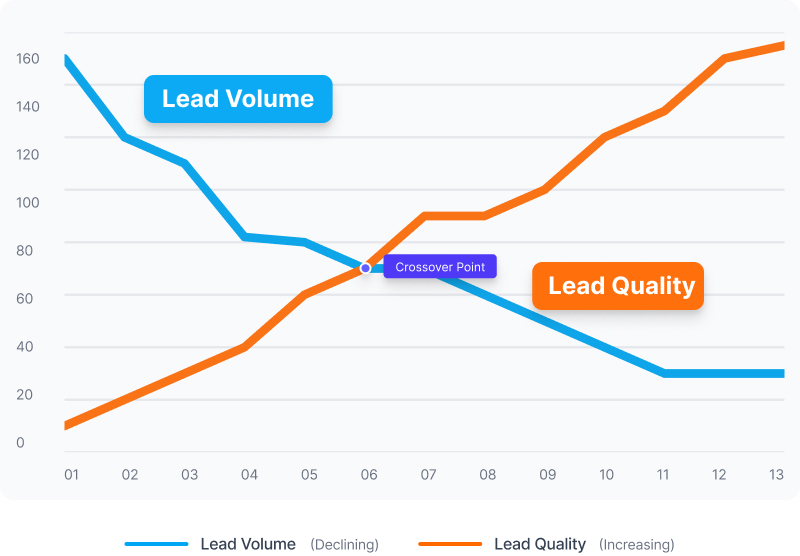
Lead volume and lead quality are often framed as competing priorities however in practice, the most effective brands recognise that both matter.
Lead volume fuels pipeline growth while lead quality determines whether that pipeline converts into revenue.
Digital journeys play a critical role in balancing these forces. When websites help buyers understand the offering, evaluate fit, and build confidence before reaching out, enquiries tend to arrive with stronger intent. The result is not simply more leads, it’s better conversations, stronger opportunities, and a pipeline that moves forward with greater efficiency.