For years, digital optimisation has focused on a single goal: conversion. How effectively a website persuades someone to buy once they arrive has been priority number one. But large language models (LLMs) like ChatGPT, Gemini, Claude and Perplexity are quietly introducing a new stage to the customer journey:
Eligibility → Selection → Persuasion → Conversion
Before a customer even lands on a website, AI systems are increasingly deciding which brands are worth recommending. This changes the optimisation landscape.
Websites still need to persuade customers once they arrive. But increasingly, they also need to be easy for LLMs to interpret, summarise and reference so they can be included in AI-generated answers.
To understand what this means in practice, we analysed five well-known brand product pages and assessed how well they align with modern Answer Engine Optimisation (AEO) principles.
1. Kathmandu
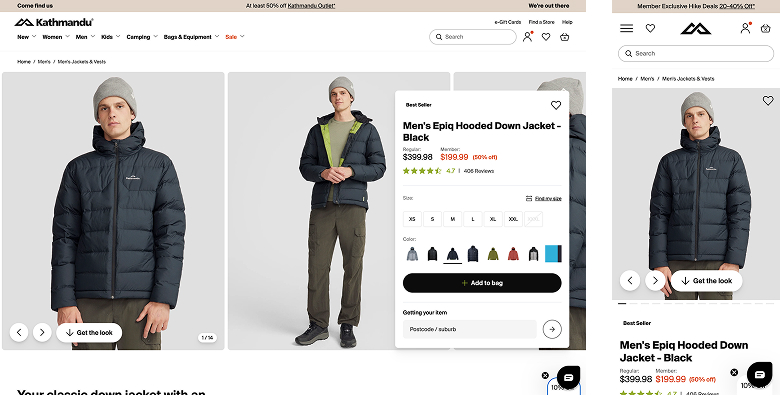
Kathmandu’s Epiq Down Jacket page is a good example of a product page that would perform well from a traditional ecommerce perspective.
The page clearly communicates the product category, presents multiple product images, and includes structured sections like key features, reviews, and product details. For human visitors, this creates a familiar shopping experience where the key information needed to make a purchase decision is easily accessible.
From an AEO perspective, there are several aspects of the page that work well.
The feature-based structure helps language models identify meaningful product attributes such as warmth, packability and water resistance. The review section also provides valuable contextual language describing real-world usage, which reinforces how the product is perceived by customers. These are powerful signals.
However, one area where the page could improve for AI interpretation is the lack of an explicit “answer-first” description.
AI systems often extract short summaries that answer queries like:
“What is the best Kathmandu Down Jacket?”
Currently, the page introduces the product through descriptive, and fairly heavy marketing brand language rather than a clear product definition.
Immerse yourself in your outdoor adventure, not the cold. Our Epiq Men’s Down Jacket is cosy, helping protect you from dropping temps on your weekday commutes and weekend pursuits.
This is where the distinction between persuasion and inclusion becomes important. Persuasive marketing language helps customers imagine the experience of owning a product. But for a brand to even be considered for inclusion in an AI-generated answer, the product must first be clearly defined for eligibility.
Providing an explicit definition makes it significantly easier for AI models to interpret, select, and extract a useful summary.
For example:
The Kathmandu Epiq Hooded Down Jacket is a lightweight insulated jacket designed for cold outdoor conditions, featuring responsibly sourced down and a packable design for travel and alpine environments.
This type of concise definition gives the LLM a clean, authoritative description that can be referenced in search results or conversational responses. Importantly, this does not mean replacing brand voice with purely functional descriptions. The real opportunity lies in balancing clear product context for machines with engaging, persuasive copy for humans.
In other words, brands need to optimise for both inclusion and persuasion, not one at the expense of the other.
Another opportunity lies in question-based structure.
AI queries increasingly resemble natural language questions such as:
- Are Kathmandu down jackets waterproof?
- How practical are they for winter travel?
- How warm is a down jacket?
Structuring sections of the page to answer these types of questions directly would make the content more aligned with how AI systems retrieve information.
2. Woolworths
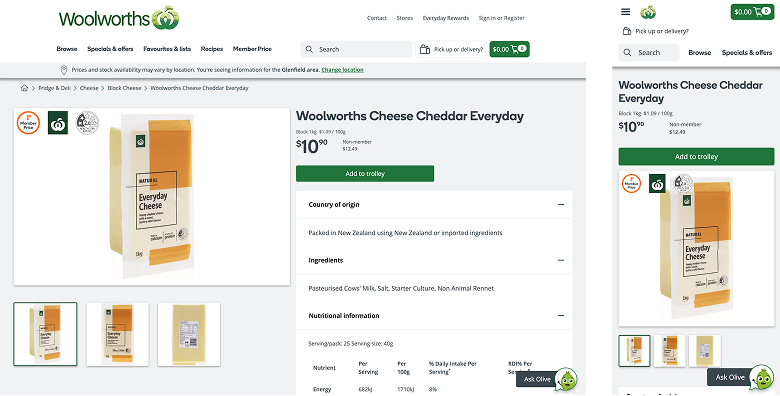
Supermarket product pages often contain large amounts of factual product data, and the Woolworths Everyday Cheddar Cheese listing is no exception.
The page provides detailed information including ingredients, allergen warnings, serving size and nutritional values. This type of factual information is highly valuable for LLMs, particularly when answering queries related to food products, dietary requirements or nutritional comparisons.
However, one challenge for AI interpretation lies in how the data is structured.
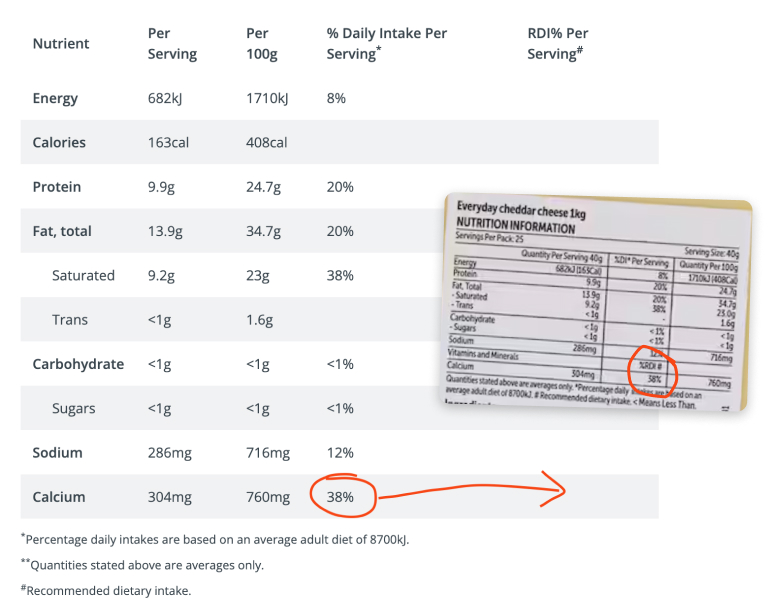
While the nutritional table contains useful information, certain fields appear incomplete. For example, the RDI percentage column does not contain a calcium value, despite calcium being listed in the nutritional information. For AI systems attempting to interpret structured data, erroneous, incomplete or inconsistent fields can reduce confidence in the accuracy of the information.
Opportunity also lies in implementing structured schema markup, particularly for food products.
Schema formats such as Product schema and Nutrition schema allow search engines and AI systems to interpret product attributes more reliably. Without these signals, models must infer meaning from HTML structure, which increases the chances of misinterpretation. This creates compliance liability and brand relationship equity risk for brands.
The page could also benefit from a short conversational product summary.
For example:
Woolworths Everyday Cheddar Cheese is a mild cheddar block designed for everyday cooking, sandwiches and family meals.
This simple type of summary makes it easier for AI systems to reference the product when answering everyday food-related queries.
3. Aesop
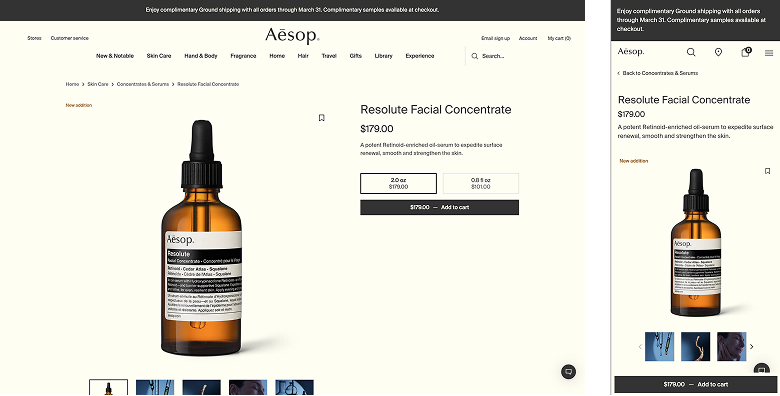
Aesop’s product pages are widely admired for their minimalist design and elegant brand storytelling. The Resolute Facial Concentrate page follows this pattern, combining product imagery with descriptive copy that communicates the sensory and botanical qualities of the formulation.
From a brand perspective, this approach works exceptionally well. However, from an LLMs perspective, it presents an interesting challenge.
The page communicates the product’s benefits, ingredients and intended use, but the information is expressed primarily through narrative language rather than structured answers.
We know LLMs typically look for concise blocks of content that clearly answer a user’s question. For example, a common skincare query might be:
“What serum is best for dry skin?”
While Aesop already structures product information in short atomic modules, these modules often describe attributes rather than explicitly answering user questions. Reframing them into question-aligned answers can significantly improve extractability for AI systems without compromising brand tone.
Existing:
Suited to: Ageing; dry to very dry; dull or patchy skin
Skin feel: Nourished, smooth and supple.
Key ingredients: Retinoid, Cedar Atlas, Squalane
Optimised:
Who is this serum best for?
Ageing skin, dry to very dry skin, and skin that appears dull or uneven.What does it do for the skin?
Helps nourish and smooth the skin while supporting hydration and improving overall texture.Key ingredients
Retinoid, Cedar Atlas and Squalane support hydration and skin renewal.
These short structured blocks give LLMs clear signals about product relevance while also introducing persuasive elements to help customers quickly understand suitability.
Another opportunity is the introduction of FAQ-style sections.
Questions such as:
- What does the Resolute Facial Concentrate do?
- When should this serum be used in a skincare routine?
- Is this serum suitable for sensitive skin?
These would align directly with conversational search behaviour and improve the likelihood of the product being referenced in AI-generated skincare advice.
4. Bunnings Warehouse
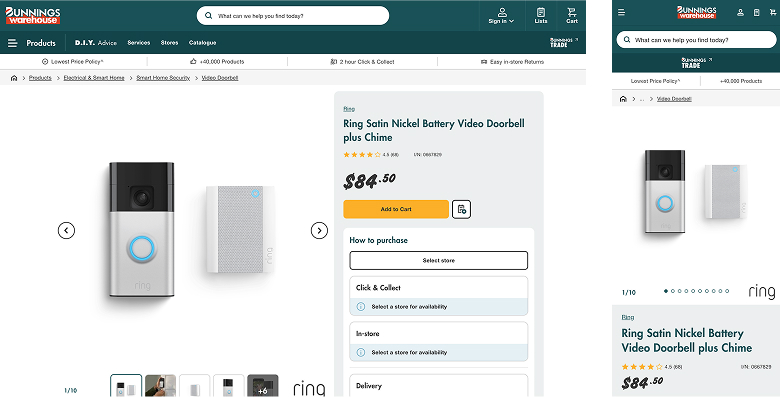
The Bunnings product page for the Ring Video Doorbell illustrates how strong technical product information can benefit AI visibility. The page includes detailed specifications, feature descriptions, ratings and reviews. This structured product information provides clear signals about functionality, performance and compatibility.
For AI systems attempting to answer questions such as:
“Do Ring video doorbells record motion?”
This level of structured information is extremely valuable.
However, like many ecommerce pages, the product description begins with feature focused, marketing-aligned language rather than an explicit product definition. Reframing the opening sentence to clearly describe the product would strengthen AI extractability.
For example:
The Ring Battery Video Doorbell Plus is a wireless smart doorbell with HD video, motion detection and two-way audio designed to improve home security.
This type of definition gives AI systems a concise description that can easily be surfaced in answer-based results.
One important distinction when optimising product pages for LLMs is the difference between brand queries and category queries. Many ecommerce pages are written assuming the visitor already knows the product they want. However, a large share of AI interactions begin at the category level, with prompts such as “What is the best video doorbell for home security?” or “How do wireless video doorbells work?”. In these situations, understanding the broader category before recommending specific products. Product pages that briefly explain the category and how the product fits within it give AI models stronger contextual signals, increasing the likelihood that the product will be referenced when answering broader questions, not just brand-specific ones.
Another area where the page could improve is product comparison structure.
Many AI shopping queries involve comparisons such as:
- Which video doorbell is best for home security?
- Is Ring better than Google Nest?
Including comparison tables or structured product comparisons would significantly increase the likelihood of the page being referenced in these contexts.
Note: AI models tend to favour structured tables because they are easier to interpret than paragraphs of descriptive text.
5. Whittaker’s
Whittaker’s is an interesting example when considering AI visibility because its website serves a very different purpose compared with many ecommerce brands.
Unlike retailers or direct-to-consumer brands, Whittaker’s does not sell its products directly online. Instead, distribution occurs primarily through supermarket and retail partners. As a result, the brand’s website functions less as a transactional platform and more as a central source of product and brand truth.
From an AI perspective, this can actually increase the importance of the website.
When LLMs attempt to understand a brand, its products, ingredients and positioning, the official brand website often becomes the most authoritative reference point. Even if the purchase ultimately happens elsewhere, the brand’s own site frequently becomes the place where AI systems extract product definitions and supporting context.
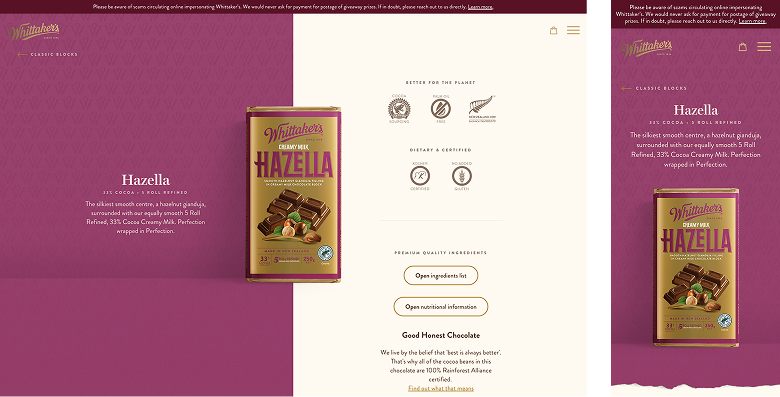
The Hazella product page contains strong brand storytelling and highlights Whittaker’s emphasis on ingredient quality and chocolate craftsmanship. These signals reinforce the brand’s reputation and help establish credibility when AI systems interpret the brand’s identity.
However, like several other pages analysed in this article, it prioritises narrative over explicit product definition. The description communicates the flavour and experience of the product, but it does not immediately provide a concise definition that AI systems can easily extract.
A simple opening sentence such as:
Whittaker’s Hazella is a New Zealand-made creamy milk chocolate block filled with roasted hazelnuts, made with Whittaker’s signature 33% cocoa milk chocolate sourced from 100% Rainforest Alliance certified cocoa beans.
would provide a clear and authoritative description that could easily be referenced when AI systems answer a question such as:
“What is the best hazelnut chocolate?”
Another interesting aspect of the page is how product claims are communicated. The Hazella block is described as containing “no added gluten.” While technically accurate, phrasing like this can sometimes blur the distinction between informative labelling and what is occasionally referred to as claim washing, where the wording may imply a stronger dietary signal than the underlying definition supports.

For LLMs attempting to interpret dietary or ingredient-related queries, clarity and precision are particularly important. If a product is described in ways that do not align clearly with commonly understood categories, such as “gluten free” versus “no added gluten” – models may be less confident referencing the product in response to queries related to dietary requirements. Or worse, the LLM may misinterpret the representation the product in its translation.
This highlights another emerging consideration for brands optimising for AI visibility. Beyond structure and schema, the clarity of product claims and definitions increasingly influences whether a product is confidently included in AI-generated answers.
What Happens When You Test AI Directly?
To understand how these signals influence visibility, we tested a series of prompts across AI systems including ChatGPT and Perplexity.
Across 25 product-related prompts such as:
- What are good chocolate brands from New Zealand?
- What down jacket is best for travel?
- What serum helps with dry skin?
we analysed which brands appeared and why.
The results showed a clear pattern.
The brands that appeared most frequently shared three common characteristics:
- Clear product definitions that AI systems could easily summarise
- Structured information blocks such as features, ingredients and specifications
- Strong external brand signals from trusted sources across the web
In other words, the brands most likely to be referenced by AI were not necessarily the ones with the most beautiful websites. They were the ones whose content was easiest for AI systems to interpret.
This is why one of our core optimisation principles is ensuring content is structured in a way that both humans and AI systems can clearly understand.
The Emerging Optimisation Layer
For years, digital optimisation focused on a simple sequence:
Traffic → Page → Conversion
AI is introducing new stages before the click ever happens.
Eligibility → Selection → Persuasion → Conversion
If your brand is not selected by AI, the persuasion opportunity never begins.
The brands that adapt fastest will not simply optimise their websites for search engines or human users. They will optimise for interpretability, ensuring their products, services and expertise can be clearly understood and referenced by AI systems.