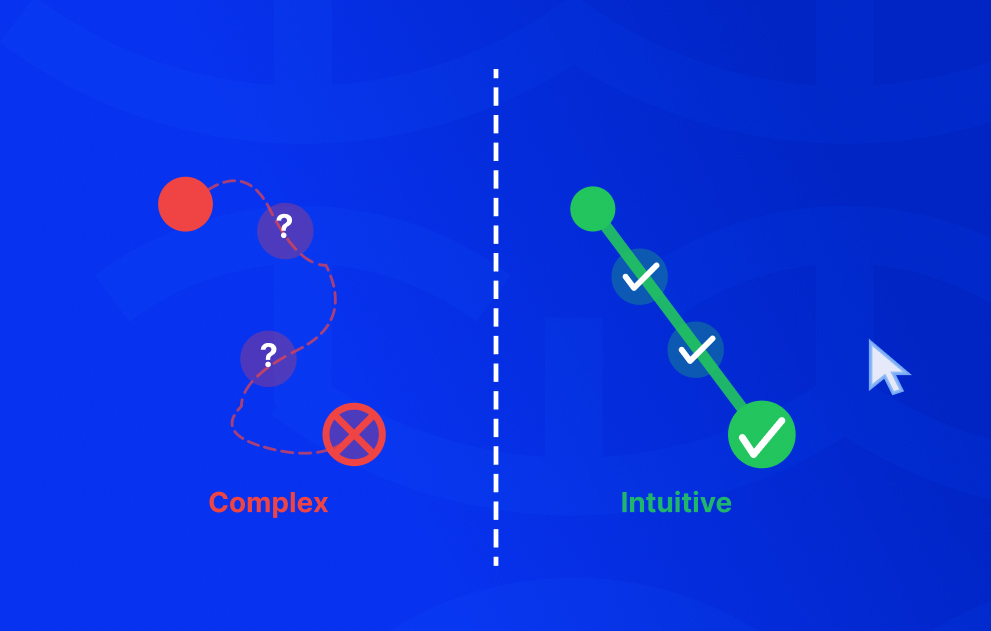
A teardown of complex e-commerce decision-making, using PB Tech as a case study
A deep and varied product catalog is the ambition of almost every e-commerce retailer. It signals scale, authority, and market leadership. More products mean more choice, broader appeal, and the ability to serve a wide range of customer needs.
For category leaders like PB Tech, product depth is not accidental. It is the result of decades of operational excellence and a deliberate focus on serving highly informed, technically capable buyers. The catalog is not just large, it represents a genuine competitive advantage.
Scale, however, introduces a less discussed trade-off.
As catalogs grow, the effort required for customers to choose correctly increases. Without active guidance, complexity begins to work against conversion. This is not because the products are wrong, but because the path to the right product becomes increasingly demanding.
In this teardown, PB Tech is used as a visible, real-world example of a challenge faced by many high-SKU businesses: how unguided complexity can quietly suppress conversion at scale. This is not a critique of execution. It is an exploration of a category-wide pattern and an opportunity to reframe complexity as a commercial advantage.
Complexity is not the problem. Unguided complexity is.
Large catalogs rarely fail because they offer too much choice. They struggle when users are left to interpret that choice alone.
Across complex e-commerce categories such as electronics, auto parts, B2B supplies, and configurable products, the same behavioural pattern appears consistently. As the number of comparable options increases, users slow down, hesitate, and defer decisions.
This aligns with well-established research on choice overload. When differentiation requires sustained cognitive effort, decision-making stalls. Users presented with many similar options are demonstrably less likely to convert, even when those options are objectively suitable.
Industry usability research, including work by the Baymard Institute, indicates that more than half of abandoned e-commerce sessions are driven by difficulty choosing or comparing products rather than price or lack of intent. Beyond immediate lost revenue, this friction increases post-purchase doubt, which can negatively affect repeat behaviour and long-term customer value.
For retailers operating at PB Tech’s scale, this creates a structural UX challenge. How do you preserve depth for experienced buyers while reducing cognitive load for everyone else?
The answer is not simplification. It is decision support.
Guide the decision rather than forcing comparison
When users are presented with dozens of near-identical motherboards, monitors, or software variants, the assumption is often that they will work it out for themselves. Many do not, particularly non-expert or infrequent buyers.
High-performing complex commerce experiences reduce friction by actively guiding users toward confidence. This guidance typically takes familiar forms:
Guided selling tools
Short, structured flows that ask a small number of questions around use case, budget, or experience level, and return a relevant shortlist.
Use-case driven filtering
Filters framed around intent, such as “best for students” or “ideal for video editing”, rather than purely technical attributes.
Comparison with interpretation
Side-by-side comparisons supported by plain-language explanations that translate specifications into practical outcomes.
Progressive narrowing
Options are reduced step by step as users commit to criteria, rather than presenting the full catalog at once.
This guidance should be selective. Experienced buyers do not need assistance and should not be slowed down. The most effective implementations use behavioural signals and segmentation to surface support only when uncertainty is present.
The objective is not to reduce choice. It is to reduce the effort required to make a confident decision.
Shift product pages from specifications to clarity
Once a product is selected, the role of the product page changes.
On many complex retail sites, PB Tech included, product pages contain extensive technical detail. This supports expert buyers and SEO requirements, but it places a heavy interpretive burden on the majority of visitors.
When value is buried beneath specifications, users must translate features into outcomes themselves. That translation gap is where disengagement often occurs.
High-converting product pages establish a clear hierarchy of information:
What the product is best suited for
Who it is designed to serve
Why it solves a specific problem
The full technical detail
For example, rather than leading with screen size, resolution, and response time, the page first establishes whether the display is suitable for design work, gaming, or general productivity. Technical specifications remain available, but they support the decision rather than lead it.
This approach does not remove detail. It reorders it. Through progressive disclosure, deeper information is revealed as users scroll or engage, allowing confident buyers to move quickly while supporting those who need clarity.
Higher-value purchases require earlier trust
As prices increase, conversion rates typically decline. This is not a pricing issue. It is a psychological one.
At higher price points, users engage in more deliberate evaluation. Loss aversion becomes more pronounced and the perceived cost of making a poor decision outweighs the excitement of purchase. As a result, journeys lengthen and hesitation increases.
In these moments, trust signals play a critical role.
On many complex commerce sites, reassurance appears too late, often buried below the fold or only visible during checkout. Effective trust reinforcement includes clear warranties and returns policies, delivery expectations, relevant social proof, and visible post-purchase support.
When these signals are surfaced earlier in the journey, particularly on higher-value items, perceived risk is reduced before commitment is required. This not only improves conversion, it shortens the decision cycle.
While the exact threshold varies by category, the shift from intuitive to deliberate decision-making often begins in the $40 to $80 range. This helps explain why conversion rate drop-offs frequently appear around the $50 to $70 mark across many e-commerce sectors.
What this means for your business
This challenge is not unique to electronics retail.
Any business with large inventories, complex configurations, mixed expert and non-expert audiences, or feature-dense products, including SaaS and B2B platforms, faces the same underlying risk.
As catalogs expand, conversion efficiency declines unless decision support scales alongside inventory.
The next phase of e-commerce will not be won by offering more products. It will be won by offering a clearer path to the right product.
Complexity does not need to be removed. It needs to be translated.
Research and references (selected)
This analysis draws on established behavioural economics research and large-scale e-commerce usability studies, alongside patterns observed across complex digital funnels.
Baymard Institute, E-commerce usability research
https://baymard.com/researchSchwartz, B. The Paradox of Choice
https://www.amazon.com/dp/0060005688Kahneman, D. Thinking, Fast and Slow
https://www.amazon.com/dp/0374533555Choice architecture and guided selling research in digital commerce (Forrester, HBR, Nielsen Norman Group)